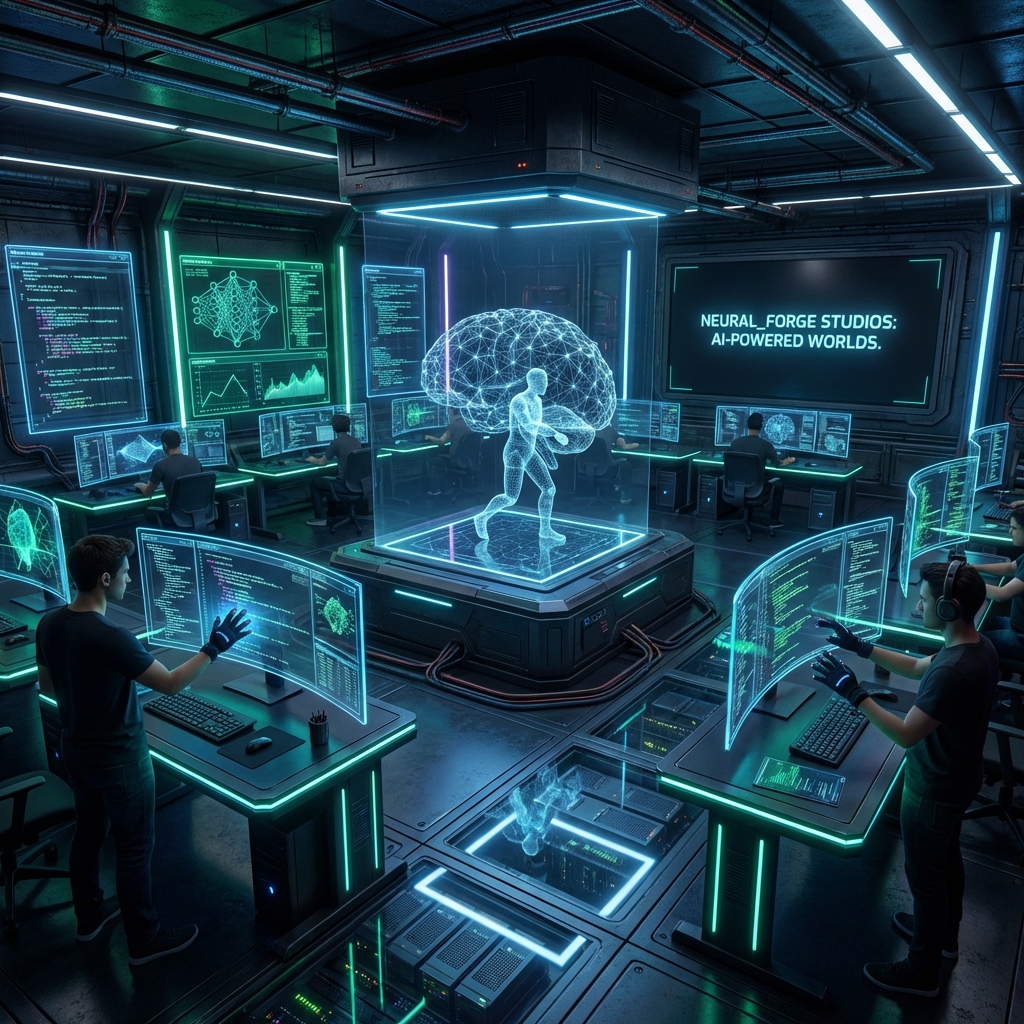
How AI is Revolutionizing Mobile Game Development in 2026
Alex Morgan
Arrof Store Team
The game industry is currently undergoing its most significant paradigm shift since the introduction of 3D graphics in the 90s. Artificial Intelligence—specifically Generative AI and Neural Rendering—has moved from experimental GitHub repositories to the core production pipelines of top-tier studios.
In 2026, “AI in Gaming” doesn’t just mean a smarter chess opponent. It means the entire game world is alive, reactive, and generated in real-time. At Arrof Store, we have fully embraced this revolution. This article outlines the specific technologies we are using to build the next generation of mobile experiences.
1. The Asset Pipeline Revolution: From Days to Minutes
Asset creation has historically been the bottleneck of game development. Modeling, sculpting, UV unwrapping, texturing, and rigging a single character could take weeks.
Generative 3D & Text-to-Texture
Using tools like Rodin-XL and Unity Muse, our artists can now generate base meshes from text prompts.
- Workflow: Artist prompts “Cyberpunk street vendor, low poly”.
- AI Output: A clean topology mesh is generated in 15 seconds.
- Human Touch: The artist then spends 2 hours refining the style, rather than 2 days building from scratch.
This hybrid workflow allows our small team to output content at the speed of a AAA studio with 500 employees.
Real-Time Texture Synthesis
On mobile, APK size is critical. Storing 4K textures for every rock and wall is impossible. Solution: We store low-res “seed” textures and use a lightweight Super-Resolution (DLSS-lite) model on the user’s phone to upscale them to high fidelity during load times.
- Reduced App Size: 1.2GB -> 350MB.
- Visual Quality: Indistinguishable from native 4K.
2. Neural Animation & Physics
Traditional animation relies on “State Machines”—a giant web of logic saying if speed > 5, play Run Animation. This often leads to sliding feet and awkward transitions.
Motion Matching & Neural Networks
We now use Learned Motion Matching. Instead of playing clips, a neural network predicts the pose of the character for the next frame based on:
- Current momentum.
- Player input intent.
- Terrain geometry (geometry under feet).
// Simplified Logic for Neural Motion
void UpdateCharacterPose() {
// Collect specific data points for the Neural Network
var inputData = new MotionInput {
trajectory = PredictPlayerPath(1.0f), // Future path
currentPose = animator.GetCurrentPose(),
groundGradient = Physics.Raycast(transform.position, Vector3.down)
};
// The Inference Engine returns the exact bone rotations
// No blending between "Run" and "Walk" clips—it's organic.
var nextPose = NeuralMotionEngine.Inference(inputData);
ApplyBoneRotations(nextPose);
}
This results in characters that don’t just “play animations”—they actually move through the world, stepping over rocks and leaning into turns dynamically.
3. The “Alive” NPC: Edge-LLMs
Players are tired of silent protagonists and repetitive NPC dialogue.
- Old Way: A JSON file with 10 pre-written lines.
- New Way (2026): On-Device Small Language Models (SLMs).
We utilize highly optimized 2-billion parameter models (like Llama-Mobile-4bit) that run directly on the Neural Engine of modern iPhones and Snapdragons.
Context-Aware Conversations
These NPCs have “Memories.” They store a compressed vector summary of your previous interactions.
- If you saved their village 5 hours ago, they remember it.
- If you stole an apple, they might be cold to you.
- They speak with personality constraints (e.g., “Grumpy Blacksmith”, “Cheerful Merchant”).
Safety Protocols: Because AI can hallucinate, we use a “Guardrail Layer” that filters the AI’s output to ensure it stays within the game’s lore and age rating.
4. Reinforcement Learning (RL) for QA Testing
Testing a massive open-world game is a nightmare for human QA testers. You can’t check every wall collision. We train RL Agents—AI bots whose only goal is to “break the game.”
- Reward Function: +1 point if you fall through the map. +10 points if you crash the game.
- Result: These bots play thousands of hours every night in the cloud. By morning, we have a heat map of every bug, glitch, and exploit in the game logic.
5. The Role of the Human
With all this automation, does the human developer disappear? Absolutely not. AI is the engine, but human creativity is the steering wheel. We are no longer “bricklayers” placing every pixel; we are “architects” designing the systems.
The games of the future will be more personal, more immersive, and deeper than ever before. And at Arrof Store, we are building that future today.